Bill was a guy who was convinced that the whole world was against him. In his own words, “I have two parents who will not leave me alone. They hassle me about everything: my homework, keeping my room clean, when I have to be in at night. They are always on my back. But I showed them! I decided to quit working in school at all. Then my English teacher started getting on my case. She kept nagging me till finally I told her where to go. Then she told me where to go—down to the vice principal. But what does he know anyway? All he did was give me detention.
But who cares? School is nothing. I went out and got a job. But do you believe it? The first day on the job, they assigned me a supervisor who tried to tell me what to do. He was nothing but a kid, barely a year older than I am and just because I wouldn't do exactly what he said to do in this stupid little job he sent me to the manager. But what does she know anyway? She's a woman and do you know what she did? She fired me. But who cares! There's plenty of jobs out there. I can get a job anywhere I want.
And then there's my girlfriend's parents who've been all over my case about getting her back on time after we go out. “Midnight is the rule, William.” I'm sick of rules. Now they won't let her go out with me at all. They're messing my life up just like everyone else. I'll tell you what! I'm so sick and tired of everyone telling me what to do that I'm out of here. I'm leaving tomorrow. I'll show them all. I'm joining the Marines.
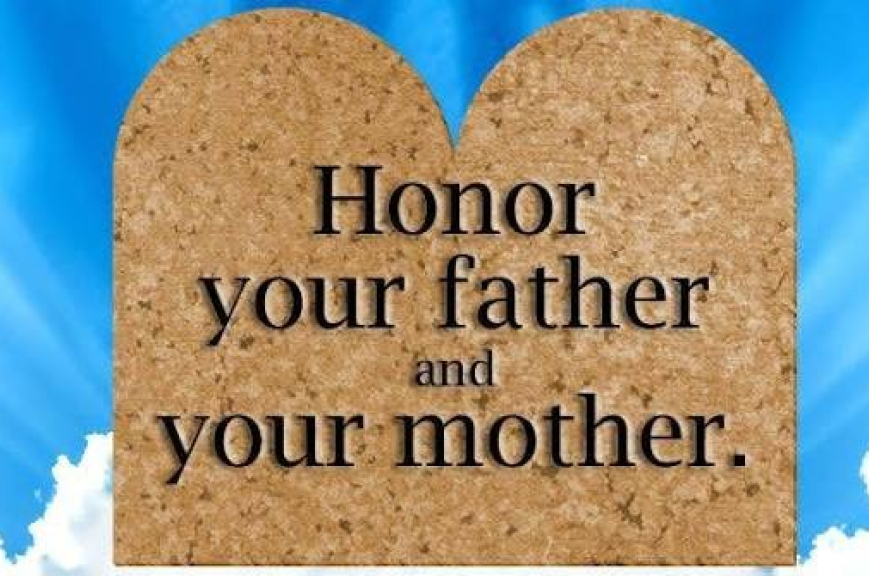
If you have picked up the stubbornness and rebellion in the heart of Bill, you have gone to the core of what the 5th Commandment is all about. This is the commandment that requires submission to authority and this is our topic for today's episode: Honor Your father and your mother as the Lord your God has commanded you so that you may live long and that it may go well with you in the land the Lord your God is giving you (Deuteronomy 5:16).
As we saw last week, Commandments 1-4 address our vertical relationship with God. But with the 5th Commandment, the subject changes to our horizontal relationships with each other. If you were God giving instructions to the human race about how to get along with each other, what would be the first thing you'd say? Don't be selfish? Don't be proud? Learn to forgive? Treat others like you want to be treated?
God's first law is “Honor your father and mother.” And in case we still don't catch the foundational importance of this command, God attaches an unbelievable promise to it. It is the only one of The Ten Commandments with this kind of promise: that you may live long and that it may go well with you. Isn't it interesting that God's first law of human relationships has to do with the family? God starts with the most basic and important cell group in society. God designed it to be the birthplace of a child's self-esteem and of his sense of identity, the place where he is to learn what it means to be loved and to give love, the place where he learns how to adapt to the way the world has been created by God to operate.
Notice, also, that his first concern, in that family discussion is that its authority structure be respected. The home is where a child learns to respect and obey authority, first that of his parents, but then, as the child grows, the authority of teachers, coaches, employers, government officials, church leaders and ultimately God himself. God's first concern for human relationships is that our homes be places where children learn to honor and respect the authority of their parents for in so doing they are learning attitudes they will need the rest of their lives whether at school at work in the military at church or anywhere else in society. Nearly every arena where human relationships are worked out has a structure of authority or accountability. So, it is no accident that God promises an enormous blessing to all who learn to respect that structure. Peter writes, “Submit yourselves for the Lord's sake to every authority instituted among men.”
In its broadest sense the 5th Commandment has always been understood by the church to require respectful obedience to those in authority in every institution of society. For example, consider question 104 of the Heidelberg catechism: What is God's will for us in the 5th Commandment? Answer: That I honor, love, and be loyal to my father and mother and all those in authority over me, that I obey and submit to them as is proper when they correct and punish me and also that I be patient with their failings, for through them God chooses to rule us. The issue of the 5th Commandment is respecting authority, which works itself out in the rest of Scripture with the command to slaves to submit to their masters, citizens to obey the state, church members to respect the authority of their elders, children to obey their parents, wives to respect their husbands’ leadership.
As we turn to the specific application of this commandment, we remember that Moses’ message was addressed to all the people of Israel, children, teens, and adults. His command to honor our parents looks different in those stages of life.
HONORING PARENTS IN VARIOUS LIFE STAGES
A. Childhood: During the early childhood years, the way that we honor our parents is simply to respectfully obey them. That was the way Paul applied the 5th Commandment to children in his letter to the Ephesians. He wrote, Children obey your parents in the Lord for this is right. “Honor your father and mother” (this is the first commandment with a promise) “that it may go well with you and that you may live long in the land” (Eph 6:1-3).
This commandment means that as parents our job is to train our children to be obedient. If your child doesn't normally obey you respectfully and right away, if you've got to coax, threaten, yell, repeat yourself over and over again to obtain obedience, you need to re-evaluate your training techniques. Parenting isn’t a job for sissies. It's our job to train our child to master his stubborn, disobedient nature. If we fail, we end up crippling our child for life. To make this point God says in Proverbs 19:18 Discipline your child while there is hope and do not desire his death. The biblical approach to parenting is to teach the child self-control, so that he can regulate himself conforming his behavior to the way God designed life to work. We might call that “obedience-centered discipline.” In contrast many in our culture follow a “child-centered” approach to parenting, which is rooted in humanism and does not take a child’s sinful nature into account, as Scripture does. One author illustrates the “child-centered” approach this way:
“After morning services little Stevie Brown was running recklessly around the church patio. Steve's dad, observing the crowd on the patio, suggested that he stop. But his mom said, “He's just being a boy. Let him run.” In contrast, Ryan Jones’ parents explained why running was not appropriate on the patio: the patio was filled with elderly people, younger children, those in wheelchairs, and mothers with babies all of whom might be hurt.”
This author continues:
“Stevie's parents are child centered. They do not realize that all their good intentions are fostering a sinful disability called me-ism or self-centeredness. Little Stevie is a perfect example of permissive parenting. He does what he wants to do when he wants to do it. Mrs. Brown represents the parents’ side of the theory. She does not interfere with his behavior, believing her little boy's freedom of self-expression is more important than the welfare of other people. Is it any wonder that children raised under such a method usually move into adulthood morally bankrupt, insensitive to the concerns and needs of others?”
God doesn't want “child centered-parenting” but “obedience-centered parenting.” We are to teach a child self-mastery, to control his impulses. God says a person without self-control is like a city that is easily broken into and without walls. We are to teach our children to be respectfully obedient to us through painful consequences for disobedience. As Proverbs 22:15 points out, Foolishness is bound up in the heart of the child the rod of discipline will remove it far from him. Self-control will prosper our child all through life. He who is slow to anger is better than the mighty and he who rules his spirit than he who captures the city (Prov 16:32).
B. Adolescence: This is the period of time during which parents gradually give their children more responsibility and more freedom. As parents pass on more responsibility, it is God’s design for parents to pass on the wisdom principles they need to make good decisions. Parents must give children enough freedom in increments so that they have room to fail, and learn from their mistakes, yet not fail so severely that they damage their lives. These, “wisdom-gaining” years are critical, and Scripture prescribes a specific way for teens to honor their parents during this stage of life is—to value their wisdom.
My son, keep your father's commandment, and forsake not your mother's teaching. Bind them on your heart always; tie them around your neck. When you walk, they will lead you; when you lie down, they will watch over you; and when you awake, they will talk with you. For the commandment is a lamp and the teaching a light, and the reproofs of discipline are the way of life (Prov 6:20-23).
In the first chapter of Proverbs, God explains the book’s purpose—"to give prudence to the simple, knowledge and discretion to the youth.” Solomon then turns to the overarching summary of the book in verse 7. The fear of the LORD is the beginning of knowledge; fools despise wisdom and instruction. Then notice the first two specific pieces of advice: 1) Vs. 8-9: Hear, my son, your father's instruction, and forsake not your mother's teaching, for they are a graceful garland for your head and pendants for your neck. 2) Vs 10. My son, if sinners entice you, do not consent.
These verses reveal God’s intention for the years of adolescence—to internalize the wisdom of Scripture and of their parents, but also to recognize the danger of being shaped instead by PEER PRESSURE. Think about this principle in light of the unprecedented epidemic of damage caused by peer pressure taking place in our culture. In 2026 we are in a crisis with our teens who have the highest rates of depression and suicide every recorded for adolescents. Why? The average teenager today spends 4 hours/day on his or her cell phone, being shaped by peer pressure that shatters his or her self-esteem. Such exposure means that for 28 hours a week our teens are squeezed into the world’s mold by their phones compared to his exposure for an hour or two to God’s wisdom in church or youth group. It is obvious that our kids are being catechized by the Internet while Christian parents today wrestle with their teens’ unprecedented exposure to peer pressure through their smart phones, peer pressure that God gives a severe warning about.
C. Adulthood: Adults honor their parents by respecting them despite their age and caring for them well. God seems to recognize the sad loss of dignity to goes along with aging. He goes out of his way to insist that this group, elderly parents, like the poor, widows, orphans, the homeless, and the sick be treated by his covenant people with a striking degree of respect, remembering that they still bear God’s image. Consider a few biblical texts.
- Proverbs 16:31: Gray hair is a crown of splendor.
- Leviticus 19:32: You shall stand up before the gray head and honor the face of an old man, and you shall fear your God: I am the Lord.
- 1 Timothy 5:8: But if anyone does not provide for his relatives, and especially for members of his household, he has denied the faith and is worse than an unbeliever.
To honor an aging father and mother requires an uncompromising devotion to caring for them. Many Christians I know have paid and are paying a high price to care for their elderly mom or dad, which is emotionally exhausting. I like to remind them that this sacrifice honors God greatly—it is the very first command to humans about how to treat other humans. Over the years, when my compassion for the elderly is failing, I have thought of the following poem composed by an elderly woman in a geriatric ward. It was addressed to the nurses caring for her. It was found among her things when she died. She didn’t quite have the courage to give it to her nurses when she was alive but after her death the hospital sent copies to every nurse in the hospital. Listen to the cry of her heart.
What do you see nurse, what do you see? Are you thinking when you look at me a crabbed old woman, not very wise, uncertain of habit, with far away eyes, who dribbles her food, and makes no reply, when you say in a loud voice, “I do wish you'd try;” who seems not to notice the things that you do and forever is losing a stocking or shoes, who resisting or not lets you do as you will, with bathing and feeding, the long day to fill. Is that what you're thinking? Is that what you see? Then open your eyes, nurse, you're not looking at me.”
“I'll tell you who I am as I sit here so still, as I move at your bidding, eat at your will. I'm a small child of 10 with a father and mother, brothers and sisters who love one another; a young girl of 16 with wings on her feet dreaming that soon a love she'll meet; a bride at 20, my heart gives a leap, remembering the vows that I promised to keep; at 25 now I have young of my own who need me to build a secure, happy home; a woman of 30, my young now grow fast, bound together with ties that should last; at 40 my young sons have grown up and gone, but my man's beside me to see I don't mourn; at 50 once more babies play around my knee—again we know children, my loved one and me; dark days are upon me, my husband is dead. I look at the future. I shudder with dread. For my young are all rearing young of their own, and I think of the years and the love that I've known.
I'm an old woman now and nature is cruel, tis her jest to make old age look like a fool. The body, it crumbles, grace and vigor depart. There is a stone where I once had a heart.” But inside this old carcass, a young girl still dwells and now again my bittered heart swells. I remember the joys, I remember the pain, and I'm loving and living life over again. I think of the years, all too few gone too fast, and accept the stark fact that nothing can last.”
“So, open your eyes nurse, open and see, not a crabbed old woman. Look closer. See me!”
The biblical mandate to treat every human with dignity is expressly addressed to adults regarding the aging parents.
HONORING GOD’S BUILDING BLOCK FOR SOCIETY IS COUNTERCULTURAL
A. We are called to stand for the nuclear family. God instituted the family before he instituted the church or civil government. It is the basic building block of society. This first and foundational institution of society is formed by the union of one man and one woman who love one another. This is the structure that is designed to be the place where children are nurtured. God makes this obvious since his creation design for creating children is for one man and one woman to conceive them in the process of making love to one another. But in numerous ways, marriage and the nuclear family are being devalued in our culture today. Here is the evidence. (Statistics shared at Colson Center’s “You Are Here” Conference by Jean Twenge.)
- Men aged 25-29 never married was 23% in 1960, 73% in 2025.
- Married men aged 25-29 was 77% in 1960, 27% in 2025.
- First marriage for women was age 20.3 in 1960, age 28.5 in 2025.
- First birth for women was age 21.4 in 1970, age 27.4 in 2025.
- Fertility rate in US 2.1 children in 2000, 1.6 children in 2025.
- 12th graders who want to have children: --From 1976-2012 for both boys and girls, remained steady, 95-96%. --By 2025, boys dropped to 91%, girls dropped to 83%.
To counter the cultural undermining of the nuclear family, Brad Wilcox, a professor at UVA, conducted extensive research comparing single adults, married adults with no kids, and adults with children. His conclusion is captured in the title of a book he published, Get Married: Why Americans Must Defy the Elites, Forge String Families and Save Civilization. Here is one part of his objective research (p. 121) that flies in the face of anti-family forces in our culture. We need to share statistics like these with our children. They prove the goodness of God’s design.
Adult Happiness: Those Who Are Very Happy or Pretty Happy
- Married w/ children: 85%
- Married no children: 72%
- Unmarried w/ children: 76%
- Unmarried no children: 67%
B. We are called to model respect for Officers of the Law. It is not by accident that the NT authors, who most clearly urged believers to respect government authority, Peter and Paul, were both unjustly executed by the Roman Government. Jesus, himself walked past fellow Jews, unjustly crucified by the Roman government on the roads of Palestine. Yet he never hinted at resistance against the Roman government. Paul summarized Jesus’ attitude perfectly. Let every person be subject to the governing authorities. For there is no authority except from God, and those that exist have been instituted by God. Therefore whoever resists the authorities resists what God has appointed, and those who resist will incur judgment. (Rom 13:1-2).
Some Christians hold a political view that disagrees with deporting those who are in America illegally. I personally favor deporting only those who have committed crimes in other countries or additional crimes here. For breaking the law when they entered the country, I support charging established illegal immigrants, with no criminal record, a fine to be paid rather, than deportation. I have close friends who disagree. But no matter what our view may be of the righteous way to treat such immigrants—there is zero justification for opposing ICE—U.S. Immigration and Customs Enforcement Officers of the Law. Zero. Paul and Peter did not say we are to obey government authority when we agree with the policies. Their words from God are directed to Christians when we don’t agree with government actions.
The fifth Commandment forbids being a part of a political or ideological movement that foments lawlessness. It is true that Scripture requires us to oppose the unjust use of force. But supporting lawlessness is not an option open for Christians unless we are directly forced to renounce our faith.
For Further Prayerful Thought:
- How would you contrast “obedience-centered training” with “child centered training?” What would you say to one who said this verse in Proverbs 22:15 encourages abuse? “Foolishness is bound up in the heart of the child the rod of discipline will remove it far from him.”
- How do the opening verses in the first chapter of Proverb juxtapose being shaped by your parents’ wisdom with being shaped by peer pressure? (See vs 8-10).
- What does it say about God that he demands that adults honor their elderly parents?
- What evidence do you see in the culture that it is anti-God’s design of the family to be the foundation of society?


